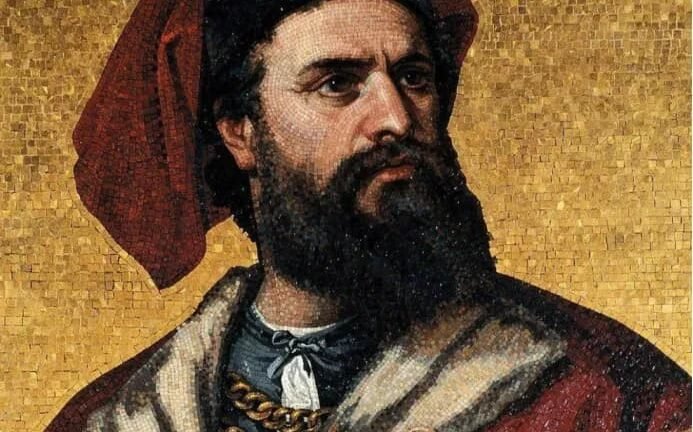
Gold, Soul and Legend: Why Did Marco Polo Travel to China?
In 1271, at the age of just seventeen, Marco Polo set out on a long journey eastward to China with his father, Niccolò, and his uncle, Maffeo. He would spend nearly twenty-five years away from home. Upon his return, he achieved enduring fame through The Travels of Marco Polo (also known as Il Milione). Why did this young Venetian embark on such a perilous journey to the remote and unfamiliar East? There was no single answer. His journey was shaped by his family’s ambitions for commercial expansion, his own fascination with the legends and wonders of the East, and the extraordinary opportunities for Eurasian exchange created by the vast Mongol Empire.
A Family Mission: Merchants Summoned by Kublai Khan
Marco Polo’s journey to China began with the extraordinary connection between his family and Kublai Khan, the Mongol Great Khan.
As early as 1260, Marco’s father, Niccolò, and his uncle, Maffeo, had travelled east on business and eventually reached the court of Kublai Khan. They became among the first Western European merchants known to have been received by the Mongol ruler. Their encounter profoundly changed the course of the Polo family’s history. Curious about the Western world, Kublai Khan commissioned the brothers to return to Europe as his envoys and deliver a message to the Pope. He asked the Pope to send one hundred learned missionaries versed in theology and the seven liberal arts to his realm. The Polo brothers accepted the mission and headed west.
Yet delays in the papal succession and the difficulties of communication postponed the mission. It was not until 1271 that Pope Gregory X provided a reply and gifts for the Great Khan, entrusting them to the brothers to carry east.
It was on this return journey that they brought along the young Marco Polo. Marco was therefore not the original initiator of the expedition; rather, he joined an official mission undertaken by his father and uncle in response to the Mongol ruler’s request. The small caravan carried the Pope’s response to Kublai Khan, representing a remarkable episode of diplomatic contact between the political worlds of Europe and East Asia, rather than merely a private commercial expedition.
Personal Aspirations: Childhood Tales Turned into Legendary Travel
If his father’s mission provided the practical reason for Marco’s journey, his personal fascination with the East fuelled his enthusiasm.
As a boy, Marco Polo is said to have listened eagerly to his father and uncle recount their adventures in distant lands. Their stories of exotic customs, unfamiliar peoples and immense wealth planted in him a deep curiosity about the East. It became a legendary realm that captured his imagination. When his father and uncle prepared to journey east once more, the seventeen-year-old Marco eagerly joined them, turning the distant world he had heard about in childhood into a reality.
His later travels reflected this fascination with both the extraordinary and the unfamiliar. During years of arduous travel, he observed local products with a merchant’s practical eye while also recording customs and traditions out of genuine curiosity. His accounts describe fire-resistant textiles from the regions of Central Asia, musk from Gansu, Buddhist monasteries in Dunhuang, and marriage customs among Tibetan peoples. What attracted him was therefore not simply the geographical reality of China, but also the extraordinary and unfamiliar world that had long existed in his imagination.
The Opportunity of an Era: East-West Routes under the Mongol Empire
Personal ambition and family duty alone, however, could not have carried Marco Polo so far. His journey became possible within a pivotal historical context: an era of unprecedented intercontinental exchange under the Mongol Empire.
During the thirteenth century, Genghis Khan and his successors launched vast military campaigns across Eurasia and established one of the largest empires in world history. Mongol rulers employed people from diverse ethnic and cultural backgrounds in their administrations and facilitated communication across their vast territories. They also developed the Yam, an extensive network of relay stations that greatly improved the movement of officials, messages and travellers. Together, these institutions contributed to increased mobility and exchange across Eurasia.
Under Kublai Khan, the Mongol-ruled territories in East Asia were connected with broader networks extending into Central Asia. Although long-distance travel remained difficult and dangerous, these political and transportation networks made journeys between Europe and East Asia considerably more feasible than they might otherwise have been.
Marco Polo and his companions reached China within precisely this historical environment. Once at the Great Khan’s court, Marco reportedly impressed Kublai Khan with his intelligence, curiosity and knowledge of foreign lands. According to his own account, the Khan subsequently entrusted him with various missions to different parts of his realm, including regions in present-day Yunnan and beyond the Yangtze River. His experience thus went far beyond that of an ordinary merchant or traveller. He became, at least according to his later narrative, a participant in the remarkable administrative and cultural networks that connected different parts of the Mongol world.
His story therefore stands as a vivid example of the large-scale movement of people, goods, ideas and information across Eurasia during the Mongol-Yuan era.
Conclusion: A Legendary Footnote to an Age
Marco Polo did not travel to China solely in pursuit of riches, even though his vivid descriptions of the wealth and prosperity he encountered would later fuel Europe’s fascination with the East. His journey grew from a diplomatic mission undertaken by his father and uncle, was driven by his own curiosity and fascination with distant lands, and was made possible by the unprecedented channels of communication and mobility that emerged under Mongol rule.
His story brought together three powerful forces: family obligation, personal ambition and historical opportunity. More importantly, it transformed one young Venetian’s extraordinary journey into a lasting symbol of cultural contact between East and West. Whether viewed as a merchant, envoy, adventurer or storyteller, Marco Polo remains one of the most celebrated figures associated with the medieval encounter between Europe and China.
